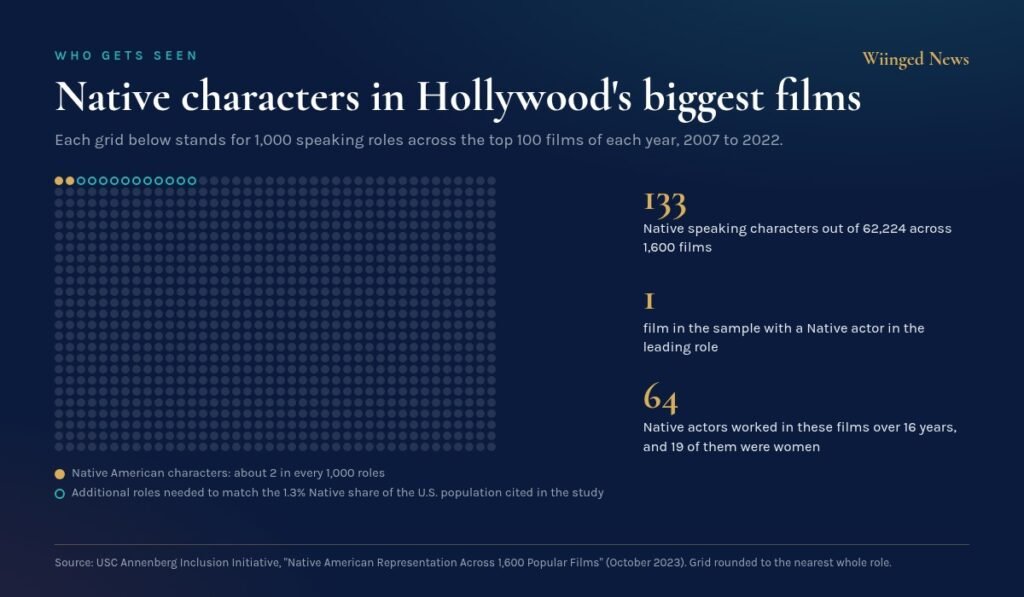
Indigenous representation on screen is still rare. In 1,600 top films from 2007 to 2022, just 133 of more than 62,000 speaking characters, about 0.21%, were Native American.
When Lily Gladstone stepped into the lead of Killers of the Flower Moon in 2023, the moment was celebrated as a breakthrough. Researchers at the University of Southern California had a blunter word for it. “Lily Gladstone’s role in Killers of the Flower Moon is quite literally an anomaly in Hollywood,” said Stacy L. Smith, whose USC Annenberg Inclusion Initiative produced the research.
Smith’s team had just finished counting. Their study of Native representation in film explains why one role could feel so rare, and it raises a question worth asking from a place like north-central Montana: who gets to tell Native stories, and where should that work begin?
How rare are Native characters in film?
Very rare: about two of every 1,000 speaking roles.
The Annenberg researchers examined the 1,600 top-grossing films released from 2007 to 2022, more than 62,000 speaking or named characters in all. Their findings are hard to argue with:
- Just 133 characters, about 0.21%, were Native American. The study cites Census figures putting the Native share of the U.S. population at 1.3%.
- Only one film had a Native actor in the leading role.
- Nearly two-thirds of Native characters were inconsequential to the plot.
- Almost 99% of the films did not include a single Native woman or girl who spoke or was named.
- Across all 16 years, only 64 Native actors appeared in these films, and most worked just once.
“Audiences would have to watch thousands of movies to see even one Native woman on screen, and very likely in a minor role,” Smith said.
Why does Native representation in animation matter?
Because animation is where kids meet their heroes.
Feature films are only part of the picture. For children, animation is often the first place they see a hero, and the first place they notice who never gets to be one. Two recent American series show what changes when Native creators are part of the process from the start.
What made Molly of Denali different?
PBS KIDS premiered Molly of Denali nationwide in July 2019. PBS described it as the first nationally distributed children’s series in the United States to feature an Alaska Native lead character: Molly Mabray, a resourceful 10-year-old who helps run a trading post in a fictional Alaska village.
The production did more than cast a Native lead. Producer WGBH developed the series with a working group of Alaska Native advisers and language advisers, hired Alaska Native scriptwriters and voice actors, and named Princess Daazhraii Johnson (Neets’aii Gwich’in) as creative producer. “I’m especially excited that Alaska Native children will get to see themselves in Molly,” Johnson said when the show was announced.
How was Spirit Rangers made?
Netflix’s Spirit Rangers, a preschool series about siblings who transform into animal spirits to protect a national park, was created by Karissa Valencia, who is Chumash. According to Variety, she assembled an all-Native writers’ room.
Valencia also went home before she went to work. “I went to my tribe and had a big meeting with the elders,” she told Variety. “I read a statement and I shared a little animation clip with them.”
The elders gave permission to adapt traditional stories and to use rock art from local caves in the animation. A second writer sought approval from the Cowlitz Tribe, the show’s other cultural foundation.
Some of us grew up on a reservation, some of us didn’t. Some were adopted out. Everyone’s story is so different.
Karissa Valencia, creator of Spirit Rangers, in Variety
What is Wapos Bay?
Wapos Bay is a Canadian stop-motion series set in a remote Cree community in northern Saskatchewan.
Long before streaming, a small studio in Saskatchewan proved that a Cree setting could carry a whole series. Wapos Bay, created by Dennis and Melanie Jackson of Saskatoon, follows a group of children growing up in a remote Cree community in northern Saskatchewan. It was made in stop-motion and aired on the Aboriginal Peoples Television Network.
The show aired in Cree, English, French and Inuktitut. Its first two seasons were coproduced with the National Film Board of Canada, its pilot won a Golden Sheaf Award for best children’s production, and its 2011 film Wapos Bay: Long Goodbyes went on to win a Kidscreen Award.
The series matters here for a simple reason. It shows that stories set in a Cree community, voiced in the Cree language and built by a small independent team, can find a national audience and win industry awards. The idea is not untested.
Why does it matter who holds the pen?
Because the shows that worked put Native people in the room from the start.
Look at the shows that worked and a pattern appears. Native people were not hired at the end to check for mistakes.
They were in the room deciding what the stories were. Cultural knowledge was treated as belonging to communities, and permission was asked before stories were adapted.
That approach also protects what should stay protected. Not every story is meant for a screen, and some knowledge is not for sale. Creators who work with elders and tribal communities from the start are better placed to know the difference.
It also frees Native characters to be people. In My Name Is Sweetgrass, Wiingashk Courchane writes, “Not every Native character has to be wise, tragic, spiritual, or heroic.” Sometimes he wants one who is funny, awkward or stubborn: a full human being.
The Annenberg report makes a similar point about the industry as a whole. Its recommendations call for project funding, development programs and even Native critics to raise both the number and the quality of Native roles.
Where can Native animators train?
There are places to train, but the pipeline is thin. The Institute of American Indian Arts in Santa Fe offers a Cinematic Arts and Technology program with coursework in animation, visual effects and sound design. The Sundance Institute created its Indigenous Program in 1994, and its Native Lab has supported emerging Native filmmakers since 2004.
But a few labs and degree programs cannot carry a whole generation. Most young Native artists, especially in rural places, still have to find their own way into animation, often with limited equipment and slow internet.
That gap is the subject of Native Youth Don’t Lack Talent. They Lack Access.
Where Cree-inspired animation fits
The About section of WiingCourchane.com describes a flagship dream: an animated series built on Cree lore, language and original characters, meant to be “a safe place for the imagination” where Native kids can see themselves as heroes in their own culture. A proposed Native Youth Media & Animation Lab, listed among the site’s projects, would train young people in animation and storytelling.
Both are ambitions at this stage, and they are described here that way. What the examples above show is that the ambition rests on solid ground. Children’s animation with a Native lead has reached a national audience.
An all-Native writers’ room has delivered a series on a global platform. A Cree community has already anchored an award-winning show.
Language is part of the story
The Chippewa Cree people call themselves Ne Hiyawak, which means “those who speak the same language,” according to the Montana Governor’s Office of Indian Affairs. At Rocky Boy’s, Stone Child College teaches Cree language courses.
Animation is one of the few formats where a language can be heard by children every day, in a story they want to watch again. That Saskatchewan series proved that a Cree-language version of a children’s series could be made and broadcast.
Why do Indigenous stories belong on screen?
Native stories belong on screen because Native people are here and already telling them, and when that work has had real backing, it has found its audience. The work now is making sure the next chance does not depend on luck.
Know a Native creator Wiinged News should cover?
Animators, writers, voice actors, teachers and studios: if you are building Indigenous stories for the screen, we want to hear from you.
Sources
- USC Annenberg, Native American characters are nearly invisible in top films, October 17, 2023.
- PBS, PBS KIDS to Launch MOLLY OF DENALI, May 9, 2018.
- Variety, How the All-Native Writers’ Room for Netflix’s Spirit Rangers Was Assembled, March 1, 2021.
- Wapos Bay series background and broadcast history.
- Montana Governor’s Office of Indian Affairs, Chippewa Cree Tribe.