A Native creative economy, rooted on the reservation but reaching well beyond it, needs three things working together: infrastructure, capital and networks.
For most of the last century, building a career in media, design or music meant moving to where the industry was. If you grew up on a reservation in north-central Montana, that usually meant leaving.
The internet was supposed to change that. In many places it did. On tribal lands, the change arrived late and unevenly, and it came bundled with other problems that a fast connection alone does not fix: thin access to credit, long drives to the nearest lender or adviser, and few links to the clients and investors who sit in larger cities.
How is the Chippewa Cree Tribe building broadband?
With a fiber network it owns, run by its own internet provider.
In June 2025, the Chippewa Cree Tribe of the Rocky Boy’s Reservation announced that it had turned up a new broadband network serving tribal households, businesses, schools, the health center and the police department. According to Ciena, which supplied the fiber equipment, the network aims to improve quality of life and economic opportunity for the Tribe’s 7,357 members. Service comes from Buffalo Rock Communications, a new internet provider owned by the Tribe.
The money came largely from the federal Tribal Broadband Connectivity Program, a roughly $3 billion effort run by the National Telecommunications and Information Administration. Congress first funded it with $1 billion in the Consolidated Appropriations Act of 2021, then added $2 billion through the Infrastructure Investment and Jobs Act. Ciena says its services team also trained tribal members to operate and maintain the network themselves.

Why does tribal ownership of broadband matter?
The part of this story that gets less attention is who keeps the revenue. Joseph Eagleman Sr., an executive with the Chippewa Cree Energy Corporation, explained it to Broadband Nation in October 2025: “Instead of profits leaving the reservation, those dollars are reinvested right here, supporting growth, jobs and services that benefit our people.”
Timing made that more urgent. When the federal Affordable Connectivity Program ended, roughly 23 million households lost help paying their internet bills, and nearly 330,000 of them were tribal members, Broadband Nation reported. A provider that answers to the community can set prices with that reality in mind.
How big is the broadband gap on tribal lands?
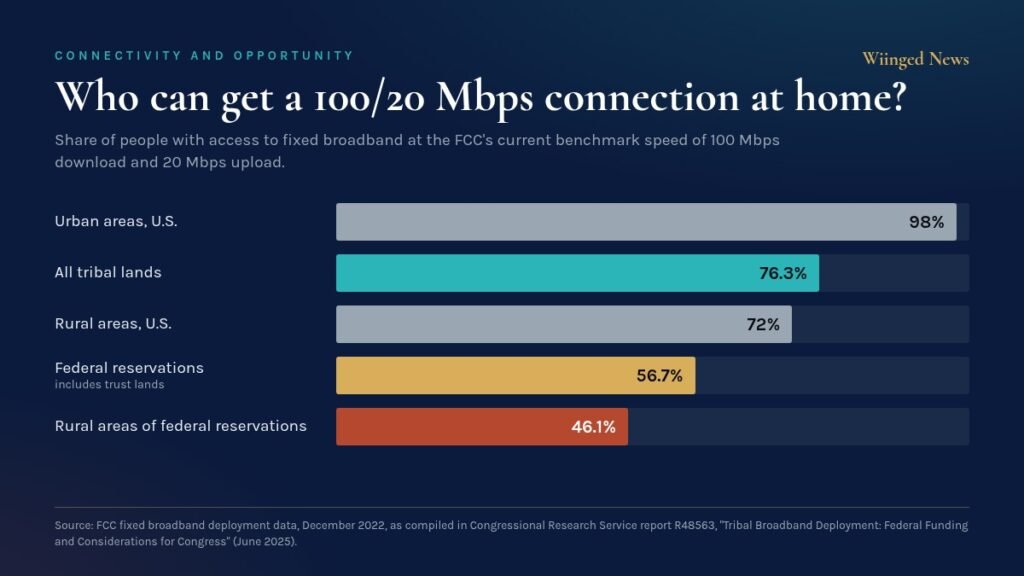
The national picture shows why this work is far from finished. A June 2025 Congressional Research Service report, using FCC data from December 2022, found that 76.3% of people on all tribal lands could get fixed broadband at 100/20 Mbps.
On federal reservations that number fell to 56.7%, and in the rural parts of those reservations to 46.1%. In urban America, it was 98%.
Why is it hard for Native founders to get capital?
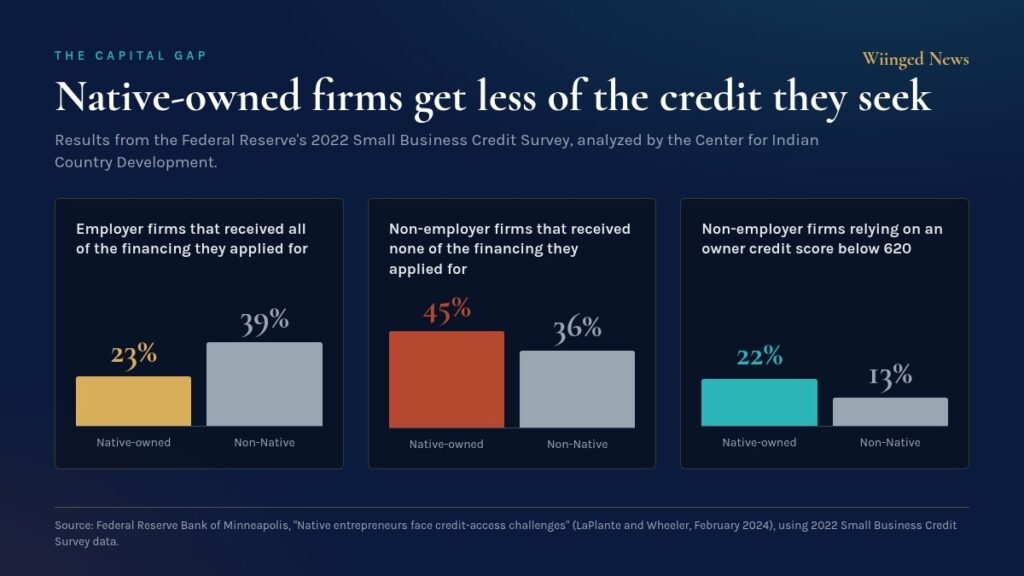
Native-owned firms are less likely to get the financing they apply for, and more likely to start with lower personal credit scores.
A connection lets a designer or video editor reach clients anywhere. It does not buy the computer, the software or the first month of rent on a studio. That takes capital, and Native founders get less of it.
The Census Bureau counted 48,582 businesses owned by American Indians and Alaska Natives in 2021. When the Federal Reserve Bank of Minneapolis’s Center for Indian Country Development studied the Fed’s 2022 Small Business Credit Survey, it found that only 23% of Native-owned employer firms received all of the financing they applied for, compared with 39% of non-Native employer firms. Among firms without employees, 45% of Native owners got nothing at all.
Personal credit is a big part of it. Small businesses often lean on the owner’s own score, and Native owners of non-employer businesses were far more likely to have scores below 620. That is a hard place to start for a 22-year-old with a portfolio, a client list and no credit history.
What is a Native CDFI?
Native Community Development Financial Institutions, or Native CDFIs, are lenders created for exactly this gap.
In a 2023 survey of Native CDFI loan funds, the Minneapolis Fed found that encouraging Native entrepreneurship was the most common strategic goal, cited by 67%. Most offer micro loans and business coaching, and many weigh character and commitment alongside credit scores. About half are headquartered on reservations.
They are also stretched. Fifty-two percent named scarce capital as one of their biggest challenges, and among those, 39% said they could lend more than three times what they do now if the money were there. For anyone who wants to invest in Native business without guessing, that is a clear signal about where funds would go to work fast.
Is a creative business a real business?
Yes. A creative economy is still an economy.
It is tempting to treat creative work as separate from “real” business. It is not. A recording studio has equipment loans and utility bills.
A design shop sends invoices and files taxes. A video team bids on work, sometimes including government contracts.
That last point is worth knowing. The Billings-based Native American Development Corporation runs an APEX Accelerator that helps Native-owned businesses in the Bureau of Indian Affairs’ Rocky Mountain and Great Plains regions find and compete for government contracts.
Public agencies buy video production, design, printing, translation and outreach. A small Native creative firm that knows how to bid has a market most people never think about.
How can Billings help Native entrepreneurs?
Billings, Montana’s largest city, is a natural meeting point for reservation communities across the region. It has banks, accounting firms, agencies, venues and an airport with regional connections. It is also where organizations like the Native American Development Corporation keep their offices.
One of the projects outlined on WiingCourchane.com builds on that geography: a proposed Reservation Entrepreneurship Network that would connect Native entrepreneurs with mentors, founders and investors, using Billings as a bridge to regional capital. It is a plan, not yet an operating program, and Wiinged News will report on it as it develops.
The logic is sound. A founder on the reservation should not have to choose between home and a seat at the table. A network that brings the table closer, in person and online, is one way to avoid that choice.
What does a Native creative economy need?
In practice, those three needs break down into five pieces: affordable connectivity, small patient capital, nearby technical help, local career pathways, and markets and mentors.
Put the pieces together and a practical agenda appears. None of it is speculative. Each part already exists somewhere in Montana or Indian Country.
- Affordable, locally owned connectivity, so that sending a 4K file or hosting a client call is routine. The Chippewa Cree network is a working example.
- Small, patient capital, especially first loans under $25,000, from lenders who know the community. Native CDFIs do this today and say they could do much more.
- Technical help within reach, including bookkeeping, contracts and bidding. Distance to advisers is one of the barriers the Minneapolis Fed researchers flagged.
- Local career pathways. Buffalo Rock Communications built two, IT support technician and fiber field technician, and committed to hiring locally.
- Markets and mentors reachable through regional hubs like Billings.
A young creator with all five of those in place can build a business without leaving home. Without them, talent keeps getting exported.
That case is made in more detail in Native Youth Don’t Lack Talent. They Lack Access.
The bigger idea
Eagleman put the stakes plainly in his Broadband Nation interview: “Most importantly, it gives us control over our own future.” He was talking about a fiber network. The same sentence works for a studio, a design firm or a media company that hires at home and sells everywhere.
In My Name Is Sweetgrass, Wiingashk Courchane puts a different test on that kind of building: growth isn’t the same as contribution. A creative economy that keeps value at home passes both.
Building something at home?
Wiinged News will keep reporting on the people and organizations building this kind of economy. If you are one of them, we want to hear from you.
Sources
- Ciena, Chippewa Cree Tribe of the Rocky Boy’s Reservation Rolls Out High-speed Broadband Network with Ciena, June 11, 2025.
- Broadband Nation, The signal stays local: Inside the Chippewa Cree Tribe’s self-run network, October 28, 2025.
- NTIA, Tribal Broadband Connectivity Program.
- Congressional Research Service, Tribal Broadband Deployment, R48563, June 2025.
- Federal Reserve Bank of Minneapolis, Native entrepreneurs face credit-access challenges and Understanding the Native CDFI landscape.