Native youth have no shortage of talent. What holds many young Native creators back is access: to broadband, capital, mentors, technology and networks.
The About section of this site describes a pattern that will sound familiar to anyone who grew up on a reservation: brilliant young artists and storytellers who went unheard, “not for lack of talent, but because no one had built the bridge to carry it out.” That is an observation drawn from experience. It is also something that can be checked.
Federal agencies, the Federal Reserve and university researchers have spent years measuring the distance between Native communities and the resources other places take for granted. Their numbers line up closely with that observation, and they point toward specific fixes.

What does access mean for Native youth?
Talent is the part nobody has to manufacture. Access is everything that has to exist around it before a sketch becomes a series, a beat becomes an album, or an idea becomes a business.
Four kinds of access show up again and again in the research: connection, money, distance and visibility.
How many people on tribal lands lack broadband?
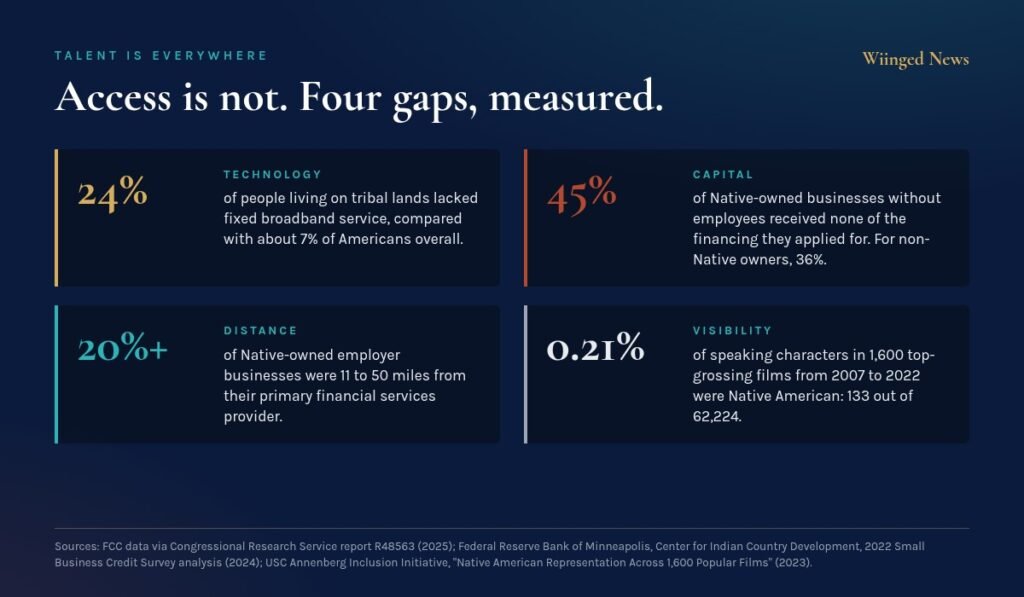
About 24% of people living on tribal lands lacked fixed broadband service, compared with about 7% of Americans overall.
A young filmmaker has to upload footage, and a musician has to send files to a producer two states away. Even a teenager selling prints online needs a store page that loads.
All of it assumes a reliable home internet connection. On tribal lands, that assumption often fails.
According to a June 2025 Congressional Research Service report, FCC data show those broadband gaps clearly. On federal reservations, only 56.7% of people had access to service at 100/20 Mbps, the current federal benchmark. In the rural parts of those reservations, the figure dropped to 46.1%.
Rocky Boy’s is one of the places working on this. In 2025 the Chippewa Cree Tribe switched on its own fiber network, run by a tribally owned provider, Buffalo Rock Communications. Joseph Eagleman Sr., an executive with the Chippewa Cree Energy Corporation, told Broadband Nation that the goal goes beyond streaming.
“Our hope is to inspire our youth to pursue futures in IT and technology,” he said, adding that the network gives young people “access to resources that support language preservation, storytelling and community ties in a digital world.” The business side of that story is covered in Native Creative Economy: Building Beyond the Reservation.
Why is it harder for Native entrepreneurs to get startup money?
Among businesses without employees, 45% of Native-owned firms received none of the financing they applied for, compared with 36% of non-Native firms.
Creative careers start with small purchases: a used camera and a memory card, a software license, a table fee at a regional market, gas money to get there. Those costs are modest, but they still require cash or credit, and Native entrepreneurs face a steeper climb to get either.
The Federal Reserve Bank of Minneapolis’s Center for Indian Country Development analyzed the Fed’s 2022 Small Business Credit Survey and found clear differences. Twenty-two percent of Native owners of businesses without employees relied on a personal credit score below 620, against 13% of non-Native owners.
The amounts involved are small. Among Native-owned businesses without employees, 66% of those seeking financing applied for less than $25,000.
In other words, the barrier is often not a giant loan. It is the first few thousand dollars.

What is a Native CDFI?
Native Community Development Financial Institutions exist to fill that capital gap.
A 2025 Minneapolis Fed survey of Native CDFI loan funds found that 73% offer micro loans for businesses and 84% offer business technical assistance. Many weigh a borrower’s character, commitment and community ties alongside credit scores. The catch: more than half said scarce capital was one of their biggest challenges.
How does distance hold young Native creators back?
Even with a good plan, someone has to be close enough to help.
Earlier research summarized by the Minneapolis Fed found a lack of financial institutions or services on or within 30 miles of reservations, which makes it harder to build relationships with banks and raises the cost of starting a business. The 2022 survey added detail: more than 20% of Native-owned employer businesses were between 11 and 50 miles from their primary financial services provider. The Minneapolis Fed researchers note that Small Business Development Centers, a common source of free coaching, are also often located far from Native-owned businesses.
Distance cuts the other way, too. Mentors, studios, investors and industry contacts cluster in cities. A young person in north-central Montana may have to drive for hours to sit in a room where decisions get made, or leave home entirely to build a career.
Some leave. Others stay and try to build at home. Both choices carry a cost.
Why does representation matter for Native youth?
When young people never see someone like them in the stories that fill their screens, it can narrow what they imagine for themselves.
The USC Annenberg Inclusion Initiative studied 1,600 top-grossing films released from 2007 to 2022. Of 62,224 speaking characters, 133 were Native American. Only one film had a Native actor in the lead.
Across 16 years, just 64 Native actors appeared in those films, and most worked only once. “Put simply, there is no career sustainability for Native actors in Hollywood,” said Stacy L. Smith, who led the study. More on that in Why Our Stories Belong on Screen.
Talent is the part nobody has to manufacture. Access is everything that has to exist around it.
What is already closing the gap for Native youth?
None of these gaps are mysteries. Each one has working models, some of them close to home.
A place to learn and make
The new Good Life Lodge on the Rocky Boy’s Reservation includes art and technology classrooms alongside its clinic, gym and teaching kitchen, according to the builder’s project summary. The full story is in Good Life Lodge: What Rocky Boy’s New Youth Center Means.
Jobs that keep people home
Buffalo Rock Communications built two career pathways for Chippewa Cree members, IT support technician and fiber field technician, and Eagleman said the focus is on hiring locally. Technical jobs inside the community are one of the most direct answers to the distance gap.
Education rooted in culture
Stone Child College, the tribally chartered college on the reservation, offers Cree language coursework as part of its catalog. Statewide, Montana’s 1972 constitution recognizes the distinct cultural heritage of American Indians and commits the state, in its educational goals, to “the preservation of their cultural integrity,” a promise the Legislature put into practice with Indian Education for All in 1999.
Training and a path into the industry
The Institute of American Indian Arts in Santa Fe runs a Cinematic Arts and Technology program with coursework in animation, visual effects and sound design. The Sundance Institute’s Indigenous Program, started in 1994, has supported emerging Native screenwriters and directors through its Native Lab since 2004.

Where this site fits
The projects outlined on WiingCourchane.com aim squarely at these gaps. They include a proposed Native Youth Media & Animation Lab for training in animation, studio mixing, podcasting, photography and storytelling; a Reservation Entrepreneurship Network linking Native founders with mentors and investors; and a Youth Business Fellowship for high school and college-age founders. These are plans, and this section will report on them as plans until there is something concrete to show.
As Wiingashk writes in My Name Is Sweetgrass, “Telling someone they’re talented is great. Helping them get the tools is better.” The research suggests the focus is in the right place.
The young people are already here. What they need is the bridge.
Share what you are building
If you run a program, a school, a lender or a business that is working on any of these gaps, Wiinged News wants to hear about it.
Sources
- Congressional Research Service, Tribal Broadband Deployment: Federal Funding and Considerations for Congress, R48563, June 2025.
- Federal Reserve Bank of Minneapolis, Native entrepreneurs face credit-access challenges, February 2024.
- Federal Reserve Bank of Minneapolis, Understanding the Native CDFI landscape, September 2025.
- USC Annenberg, Native American characters are nearly invisible in top films, October 2023.
- Broadband Nation, The signal stays local: Inside the Chippewa Cree Tribe’s self-run network, October 2025.